Types of marble: the most popular varieties and how to choose
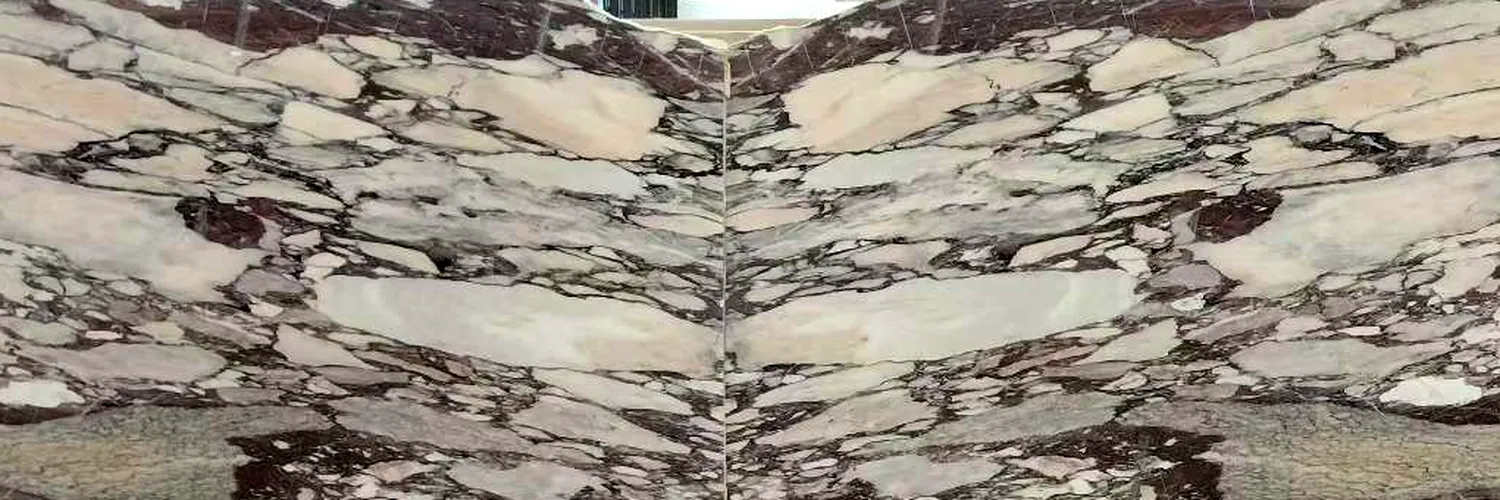
There are hundreds of marbles, and their trade names vary from one supplier to another. This guide gathers the most sought-after ones, grouped by colour, with photos of real slabs from our catalogue.
Italian whites: the most coveted
They come mainly from the Carrara quarries in the Apuan Alps (Tuscany). They differ in the intensity of their veining:
- Carrara: greyish-white background with fine, soft veins. The most understated and versatile.
- Calacatta: whiter background and thicker, bolder veins. The favourite for designer kitchens.
- Statuario: bright white with dramatic grey veins. One of the most exclusive.
- Calacatta Viola: white with burgundy and violet fragments and veins. Pure personality.
Other prized whites include Greek Thassos White, with almost no veining, and White Serpeggiante, with linear grey veins.
Spanish marbles
Spain is one of the world's major marble producers, with areas such as Alicante and Macael (Almería). A few classics:
- Rojo Alicante: intense red with white veins, back in fashion in contemporary design.
- Rosa Valencia: salmon pink, warm and Mediterranean.
- Crema Marfil, Negro Marquina and Emperador: the classics for floors and bathrooms. Ask us about availability.
Greens, reds and colour
- Verde Alpi: very dark green with light veins, from the Aosta Valley. Classic elegance.
- Breccia Pontificia: Italian breccia with large wine-red veins.
- Rosso Lepanto: burgundy with a network of white veins.
- Giallo Siena: ivory with yellow and ochre veins.
- Cipollino: wavy, layered veins, like an onion.
Greys and banded marbles
- Orobico Grey: grey and black bands that form spectacular herringbones when book-matched.
- Invisible Grey: white with light grey fragments, very current.
- Tanganica: light grey with wavy veins.
How to choose your marble
- Think about the use. For bathrooms, walls and floors any marble is a great choice. For a hard-working kitchen, consider a quartzite that looks like marble.
- Look at real slabs, not small samples. A 10 × 10 cm piece does not show how the veining behaves over 3 metres.
- Think about bookmatching. If you use two consecutive slabs, opening them like a book creates striking symmetrical patterns.
- Choose the finish: polished for shine and deep colour; honed for a matt, natural look; leathered for a textured feel that hides fingerprints.
Our catalogue includes many of them, with photos of real slabs from our warehouse.
Have a project in mind?
Ask us for a no-obligation quote: we will reply with an indicative price.