Patagonia quartzite: what it is, how slabs vary and where to use it
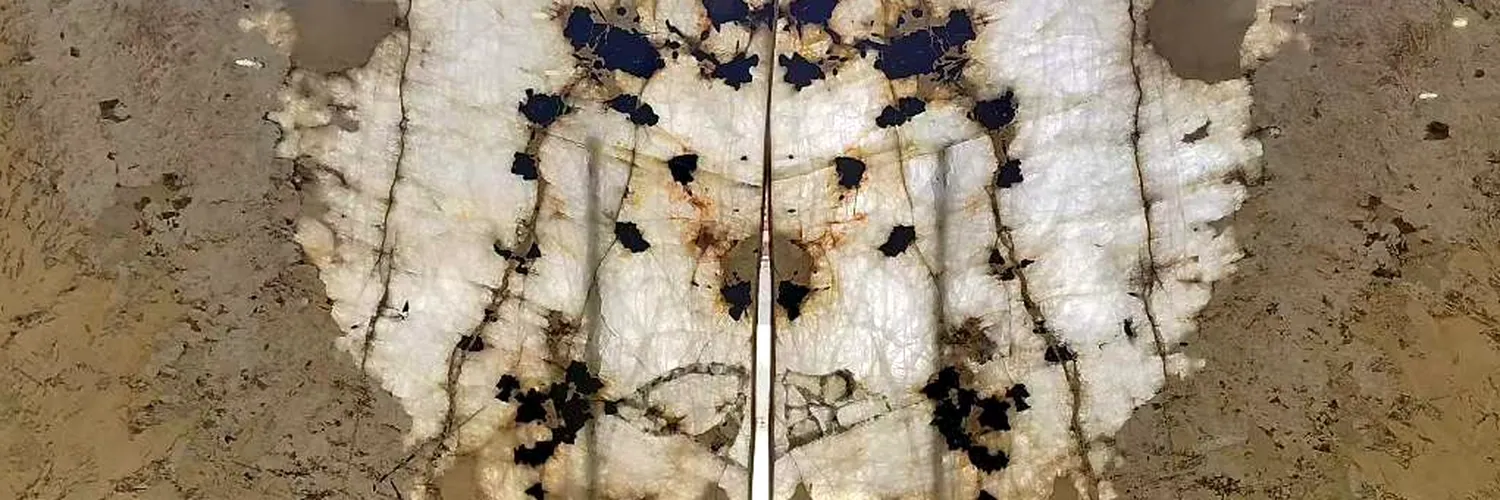
Patagonia is one of those stones you recognise at a glance: large areas of almost transparent white crystal, black patches and rust-coloured veins on a cream background. Here is what it is, how to choose a slab and where it looks its best.
What Patagonia is
Patagonia is a Brazilian stone sold as a quartzite. In some markets it is also sold as an "exotic granite", because it is made of a mix of minerals. Quartz is the star: it forms the translucent white crystal areas. Other minerals add the dark patches and the gold and rust tones.
Despite the name, it does not come from Patagonia in Argentina. It is a trade name, as with many stones.
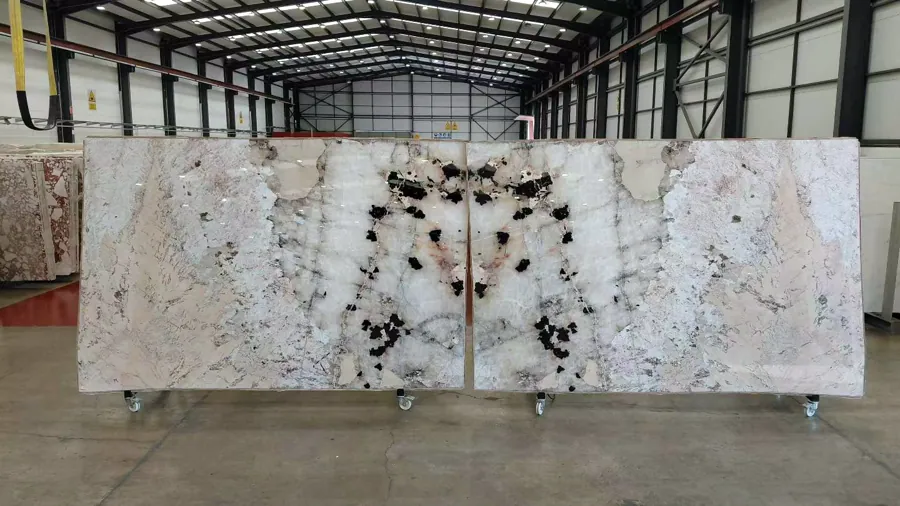
Every slab is completely different
With Patagonia, the difference between one slab and the next is huge. One can be almost all white crystal and the next can have large dark areas. That is why:
- Choose the actual slab, never from a small sample or a generic catalogue photo. You can see real slabs on our Patagonia page.
- If you need several slabs (a large island or a wall), ask for consecutive slabs from the same block. The pattern then flows across them and you can book-match them.
- Decide in advance where you want the white crystal and where the dark areas should fall. On an island, for example, place the most striking part of the slab where it will be seen most.
Can it be backlit?
Yes, and that is one of its big attractions. The crystal areas let light through, so with LED backlighting the stone takes on an almost onyx-like glow. Not all of the slab transmits light equally: the crystal glows and the dark areas stay opaque, and that contrast is exactly what makes it spectacular. To do it well, see our guide to backlit stone.
Where to use it
- Kitchen islands and bars: its signature use, especially with a backlit front.
- Feature walls in living rooms, receptions and restaurants.
- Bathroom vanities, where a single slab gives character to the whole room.
- Dining and coffee tables.
Because it is so striking, it works best as a one-off piece surrounded by calm materials: wood, white, dark metal.
Durability and care
Quartz is much harder than marble, so Patagonia stands up to everyday scratches and acids far better than a marble does (see marble vs quartzite). Even so, keep in mind that:
- It is normal for slabs to be reinforced with mesh and resin on the back, and to have small fissures or pits filled with resin on the face. This is standard for stones with so much crystal and is not a defect.
- Those resins do not like direct heat: always use trivets for pots and pans.
- It should be sealed, and it is worth repeating the water-drop test from time to time, because some areas absorb more than others.
- Mild soap and water are all you need for cleaning.
How much does it cost?
Patagonia is a high-end exotic stone. Its price depends heavily on the specific slab (how much crystal it has, its size and thickness) and it changes with the market, so any fixed figure would soon be out of date. The reliable way is to ask about the slabs in stock right now: request a quote with your measurements and we will send you photos and prices of real slabs.
Similar stones
- Alpinus Patagonia: a grey background with crystal areas and golden flecks.
- Patagonia Green: a white background with bold green, grey and black veins.
- Four Seasons: another multicoloured quartzite for statement pieces.
Have a project in mind?
Ask us for a no-obligation quote: we will reply with an indicative price.